

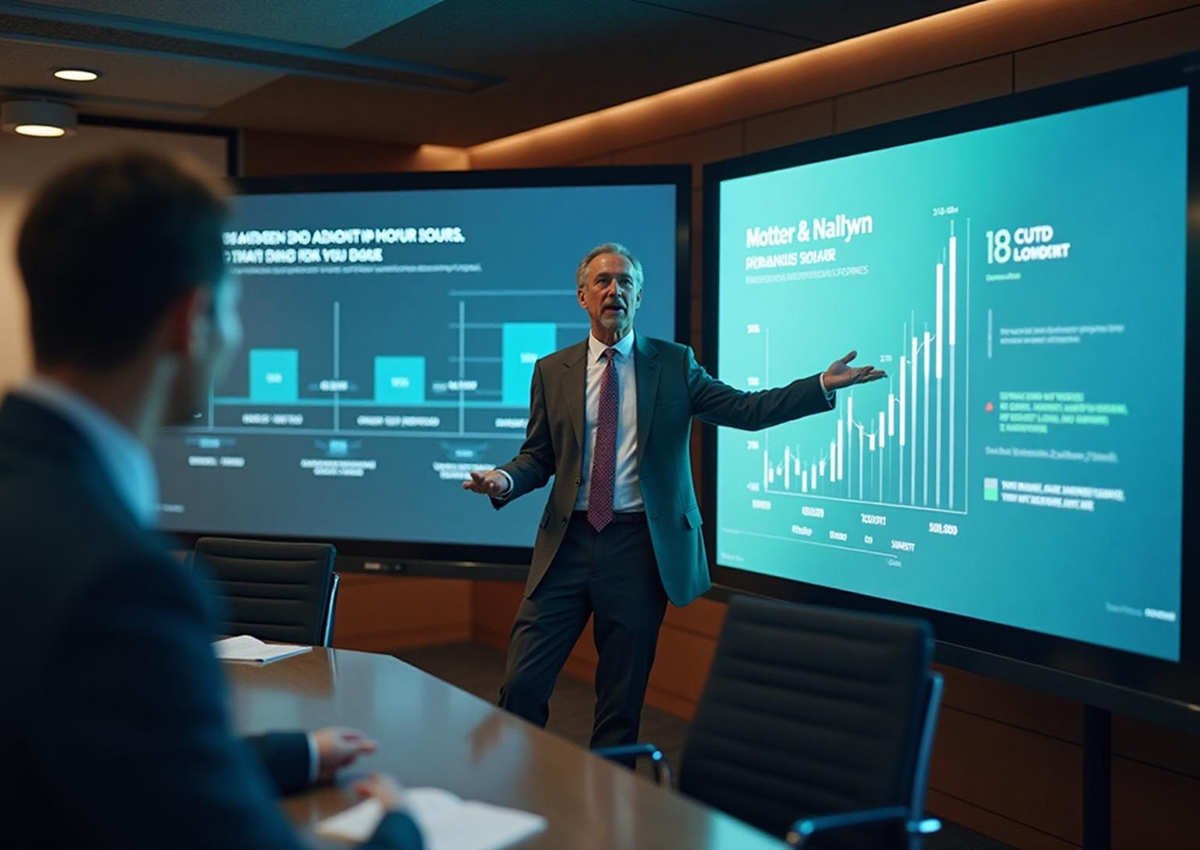
Is your finance team still seen as a group of scorekeepers? Is the monthly reporting cycle a frantic exercise in compiling historical data that arrives too late to influence key decisions? If so, you are not alone. According to a recent McKinsey report, while 80% of CFOs believe their teams are effective business partners, only 25% of other C-suite executives agree [1]. This staggering perception gap highlights a critical reality: most finance functions are failing to deliver on their strategic potential.
The traditional finance organization, built for a world of stable, predictable industrial cycles, is fundamentally broken. It is designed to be a fortress of control, focused on protecting value through budgeting, compliance, and historical reporting. Its primary output is the Profit & Loss (P&L) statement—a rearview mirror that tells you where the company has been, but offers little guidance on where it is going.
In today’s volatile, digitally-driven economy, this model is no longer just suboptimal; it is a competitive liability. Companies that elevate finance from scorekeeper to strategic partner gain a decisive edge. As a Boston Consulting Group (BCG) study notes, organizations with top-quartile finance functions see significantly higher total shareholder return (TSR) [2]. They do not just react to the numbers; they use them to steer the business, anticipate change, and unlock new avenues for growth.
Building a truly strategic finance function is not about buying new software or hiring more analysts. It is a fundamental transformation of the function’s operating model, talent, and mindset. It requires moving beyond the P&L to focus on the forward-looking drivers of value. This article provides a practical, battle-tested framework for CFOs ready to lead this change and build a finance function that is fit for the future.
The P&L Trap: Why Historical Metrics Are Holding You Back
The P&L statement is the bedrock of traditional accounting. It is essential for regulatory compliance and investor reporting. However, as a tool for strategic management, it is deeply flawed. It encourages short-term thinking, obscures the true drivers of value, and provides lagging indicators that are often irrelevant in a fast-moving digital economy.
| The P&L Trap | The Strategic Consequence |
|---|---|
| 1. Short-Term Focus | The quarterly and annual rhythm of P&L reporting incentivizes managers to hit short-term earnings targets, often at the expense of long-term value creation (e.g., cutting R&D or marketing to make the quarter). |
| 2. Lagging Indicator | The P&L reports on what has already happened. By the time the data is compiled and analyzed, the opportunity to influence the outcome has passed. It is like trying to drive a car by looking only in the rearview mirror. |
| 3. Obscures Value Drivers | The P&L aggregates vast amounts of data into high-level categories, making it difficult to identify the specific operational drivers of performance. It tells you what happened, but not why. |
| 4. Poor Fit for Digital Business | For companies built on intangible assets (like software, data, and brand), the P&L can be actively misleading. Investments in customer acquisition or software development are treated as expenses, depressing current earnings even as they build long-term value [3]. |
A finance function that is trapped by the P&L is relegated to the role of a historian. It can tell you, with great precision, how the battle was lost. A strategic finance function, in contrast, is a co-pilot, using real-time data and predictive insights to help the business navigate the battlefield and win the war.
The Strategic Finance Blueprint: Three Pillars of Transformation
Transforming the finance function from a cost center to a value-creation engine requires a deliberate and sustained effort across three key pillars: a Next-Generation Operating Model, Data-Driven Insight Capabilities, and a Business Partnering Mindset.
Pillar 1: The Next-Generation Operating Model
The traditional, hierarchical structure of the finance department is too slow and siloed for the modern era. A strategic finance function adopts a more agile, networked operating model, often referred to as the “Finance Business Partner” model.
According to McKinsey, the future of finance is a network model where “business partners draw on a shared pool of analysts, who are assigned to specific work items based on… a clear prioritization of the company’s value-creation agenda” [4].
How to Implement:
- Centralize Transactional Work: Automate and centralize routine, transactional tasks (such as accounts payable, payroll, and basic reporting) into a shared service center or through Robotic Process Automation (RPA). This frees up your most valuable talent to focus on higher-value activities.
- Create Centers of Excellence (CoEs): Establish specialized CoEs for complex, technical areas like tax, treasury, and advanced analytics. These CoEs provide deep expertise and support to the entire organization, ensuring consistency and quality.
- Embed Finance Business Partners: The most critical shift is to embed senior finance professionals directly into the business units. These are not accountants; they are strategic advisors. Their role is to sit at the table with business leaders, helping to shape strategy, model scenarios, and drive performance. They are the primary link between the business and the finance function.
Pillar 2: Data-Driven Insight Capabilities
A strategic finance function does not just report data; it generates insight. This requires moving beyond Excel and embracing a modern data and analytics stack.
How to Implement:
- Build a Single Source of Truth: The foundation of any analytics capability is a clean, integrated data platform. This means breaking down data silos and creating a single, trusted source for all key financial and operational data. This is often the most challenging, but also the most important, step.
- Focus on Drivers, Not Just Outcomes: Shift your analytical focus from what happened (e.g., “revenue was down 5%”) to why it happened (e.g., “customer churn in the enterprise segment increased by 2%, driven by a recent product change”). A BCG report emphasizes focusing on “drivers that influence the metrics that matter most to the business” [5].
- Invest in Predictive Analytics: The ultimate goal is to move from hindsight to foresight. Leverage statistical modeling and machine learning to build predictive forecasts for key business drivers. Instead of just reporting last month’s sales, you can provide a probabilistic forecast for next quarter’s sales, along with the key drivers and risks.
Pillar 3: A Business Partnering Mindset
Technology and structure are only enablers. The real transformation happens at the human level. It requires a fundamental shift in the mindset and skills of your finance team.
How to Implement:
- Recruit for “Financial Athletes”: When hiring, look beyond traditional accounting skills. Seek out candidates with a blend of financial acumen, strategic thinking, communication skills, and a natural curiosity about the business. These are the “financial athletes” who can thrive in a business partnering role.
- Develop Commercial Acumen: Invest heavily in training your team on the commercial aspects of the business. They should understand the company’s strategy, its competitive landscape, its customers, and its operational processes as deeply as they understand a balance sheet.
- Measure and Reward Partnership: Change your performance management system. Do not just reward your team for closing the books on time. Reward them for the quality of their insights, the strength of their relationships with business leaders, and their tangible impact on business outcomes.
The First Move: Launch a Lighthouse Project
Transforming the entire finance function can feel like a daunting task. The key is to start small, prove the value, and build momentum. Select one business unit or one critical business problem and create a “lighthouse” project to pilot the new model.
- Select the Right Partner: Choose a business unit leader who is open-minded, influential, and facing a complex strategic challenge.
- Assemble a Cross-Functional Team: Create a small, dedicated team consisting of a finance business partner, a data analyst, and key members from the business unit.
- Define a Clear Objective: Focus on a single, high-impact problem. For example: “Identify the key drivers of customer churn in the SMB segment and develop a plan to reduce it by 15% over the next six months.”
- Deliver Actionable Insights, Not Just Reports: The output of the project should not be a 100-page slide deck. It should be a small set of clear, actionable recommendations, backed by data, that the business unit can implement immediately.
By delivering tangible value on a focused project, you will create a powerful case study for the new model. The business unit leader will become your biggest advocate, and other leaders will soon be demanding their own finance business partner. This is how you build a groundswell of support and drive a lasting transformation.
The journey from a traditional, P&L-focused finance function to a strategic, value-creation engine is one of the most important legacies a CFO can build. It is a journey that transforms not only the finance department but the entire enterprise, creating a more agile, insightful, and competitive organization.
References
[1] McKinsey & Company, “The new CFO mandate: Prioritize, transform, repeat,” May 2021.
[2] Boston Consulting Group, “Finance Function Excellence,” accessed January 11, 2026.
[3] Vijay Govindarajan, “Why Financial Statements Don’t Work for Digital Companies,” Harvard Business Review, February 2018.
[4] McKinsey & Company, “Finance 2030: Four imperatives for the next decade,” November 17, 2020.
[5] Boston Consulting Group, “5 Building Blocks to Improve Financial Steering,” April 17, 2023.
Download this Article: Beyond the P&L: How to Build a Truly Strategic Finance Function (PDF)

Share this article